
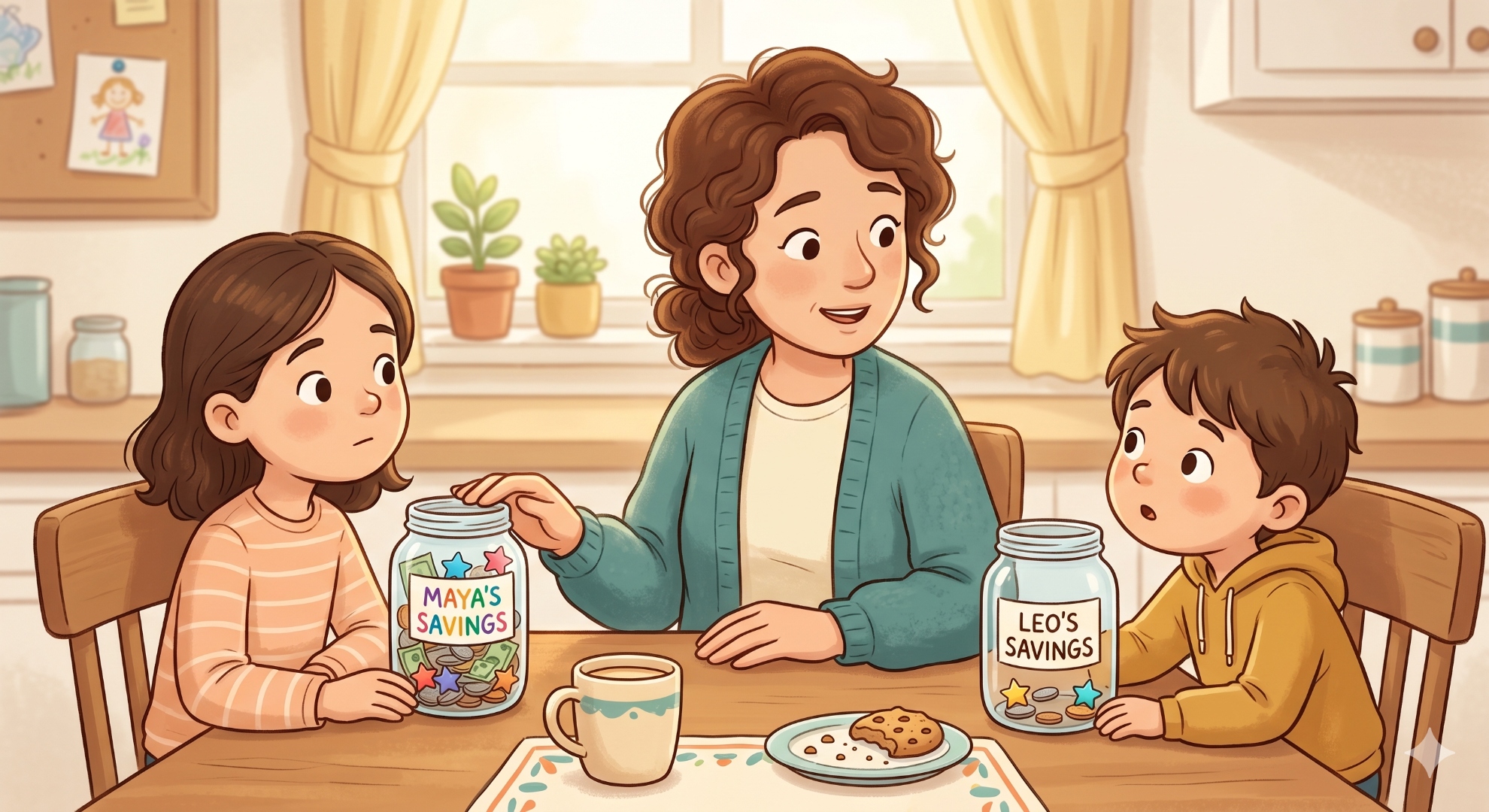
Few things stir up big feelings faster than one child noticing the other has more. More money. More chores. More choices. More freedom.
And then it comes.
"That's not fair."
Sometimes it is about allowance. Sometimes it is about birthday money. Sometimes it is about the older sibling getting opportunities the younger one has not grown into yet. And if you are a parent, it can feel like you are walking a tightrope.
You want to be fair. You want to avoid constant comparison. You do not want money becoming one more thing your kids fight over.
The truth is, fairness and sameness are not always the same thing. That is one of the hardest lessons for children to learn — and one of the most important.
Why Siblings Compare So Quickly
Siblings live close to each other's lives. They see what the other gets. They notice whose jar has more crumbs. They know who got paid for what. They watch what rules seem to change with age.
They are not looking at your big picture as a parent. They are looking at the one thing right in front of them.
- "My sister got five dollars."
- "My brother gets more jobs."
- "She got to buy that and I didn't."
That is normal. Comparison is easy when two people live under the same roof but are in different seasons of life.
Fair Does Not Always Mean Equal
This is one of the best phrases you can teach early: fair does not always mean the same.
Fair means everyone gets what fits their age, needs, and responsibilities. A five-year-old and a ten-year-old should not always have the same money system — because they do not have the same responsibilities, the same understanding, or the same opportunities.
If you try to make everything identical, you may create peace for five minutes, but confusion over the long run. Kids need help understanding that differences can still be fair.
Explain the Why in Simple Language
Children handle differences better when they understand the reason. You do not need a long speech — just simple truth.
You might say:
- "Your brother is older, so he has extra jobs and extra chances to earn."
- "You are younger, so right now your job is learning how to use small amounts well."
- "When you grow, your opportunities will grow too."
- "Fair means each person gets what fits them right now."
You are helping them connect money to growth, not favoritism. That matters. Because when kids do not understand the why, they often make up a story — and the story is usually something like: "They are loved more" or "I am missing out." Clear words can keep that story from taking root.
Talk About Responsibilities, Not Just Rewards
Money often feels unfair to kids when they only see the reward and not the responsibility attached to it. An older sibling may get more allowance, more spending freedom, and more earning options — but they may also have more chores, more expectations, and more accountability.
Help your younger child see the full picture. You might say:
- "She gets more because she is responsible for more."
- "He has more jobs because he is older and able to do more."
- "With more freedom comes more responsibility."
This helps money feel less random. It also quietly teaches that growth brings both opportunity and responsibility together.
Do Not Force Everything Into One System
Some parents feel pressure to make one single system fit every child. But different children may need different approaches. One child may do well with a simple jar system. Another may be ready for small paid jobs. One may save naturally. Another may need more structure.
That does not mean you are being unfair. It means you are paying attention.
You can say: "Not everything in our family looks exactly the same, because each person is growing in different ways. Our goal is not to make everyone match. Our goal is to help everyone grow."
That is a much healthier target.
What To Say When One Sibling Says "That's Not Fair"
You do not need to panic — and you do not need to defend every detail. Try simple responses like:
- "I hear that this feels unfair to you."
- "You are noticing a difference."
- "Different does not always mean unfair."
- "Let's talk about what is different here and why."
- "Your turn for that kind of responsibility will come."
These phrases lower the heat without dismissing the feeling. You are not saying "Stop comparing." You are helping them understand what they are seeing.
Reduce Jealousy by Naming What Each Child Has
Sometimes comparison shrinks when children can clearly see what belongs to them. You can help by naming each child's current season.
For example:
- "Right now, your sister has more earning jobs. Right now, you have fewer jobs but more help."
- "He is working on learning how to budget. You are working on learning how to save toward one goal."
This gives each child a path. Instead of feeling like one sibling is ahead and the other is behind, it helps them feel like they are each learning what fits them right now. That can lower sibling jealousy about money a lot.
Create Individual Goals, Not Just Shared Comparisons
Comparison gets stronger when siblings only look sideways. It gets weaker when they each have something meaningful in front of them. That is why individual goals help so much.
One child may be saving for a Lego set. Another may be saving for art supplies. Another may be learning how to divide crumbs into Smart, Sweet, and Heart.
Now the question is not "Why do they have more?" — it becomes "What am I working toward?" That shift is powerful. You are moving them from rivalry to responsibility.
Do Not Use One Child as the Lesson for the Other
This is a subtle one, but it matters. Try not to say things like:
- "Why can't you save like your sister?"
- "Your brother doesn't complain about this."
- "Look how responsible she is."
Even if you are trying to motivate, comparison usually creates shame, not growth. Instead, keep the lesson personal:
- "Let's look at your choices."
- "What would help you with your own goal?"
- "You are learning your own money habits."
Kids do better when they feel coached, not compared.
Have a Few Family Money Phrases Everyone Knows
It helps to repeat a few simple truths often, so kids and money conflict does not have to be solved from scratch every time. You might use phrases like:
- "Fair does not always mean the same."
- "With more freedom comes more responsibility."
- "We are each learning what fits our age right now."
- "Money grows with wisdom, not just with age."
- "We do not compare jars. We focus on our own crumbs."
Those little lines become anchors. Over time, your kids start to hear them in their own heads. That is when family language starts becoming family wisdom.
What You Are Really Teaching
When you handle sibling fairness well, you are teaching more than money. You are teaching that growth happens in stages, that different responsibilities can lead to different outcomes, that jealousy can be named without being in charge, and that fairness is about wisdom — not sameness.
Those are lessons your kids will need for life. Not just with siblings. With classmates, coworkers, friends, and one day in their own families.
This is bigger than allowance. It is training for how to live around other people without comparison ruling the room.
One Conversation at a Time
Your kids will compare. That part is normal. The goal is not to eliminate every "That's not fair" moment. The goal is to help them understand what is actually fair, what is simply different, and what they are responsible for in their own season.
That takes repetition. Calm. Clear words.
And when you keep showing up that way, money stops becoming a constant sibling fight. It becomes another place where they learn: I have my own path. I have my own responsibilities. And I can grow from here.
One child. One jar. One conversation at a time.