
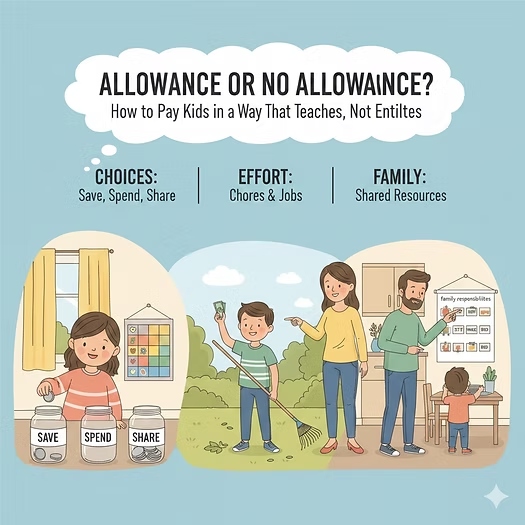
At some point, every parent hits the same question.
“Should we give our kids an allowance?”
You want them to learn responsibility.
You do not want them to feel entitled.
You want money to feel normal, not stressful.
And somewhere between “no allowance at all” and “pay them for every little thing” is a balance that actually teaches something useful.
This is a guide to help you find that balance for your family.
What Allowance Can Actually Teach
Allowance is not just about handing over money.
Used well, it can teach three big ideas.
- Money comes with choices. 1. When kids control a small amount of money, they feel the trade-offs. Spend now or save. Treat or toy.
2.
- Money connects to effort. 1. Even if you are not paying for every chore, you can link money to contribution, follow-through, and responsibility.
4.
- Money is not magic. 1. It does not “just appear.” It is something the family manages together.
6.
The goal is not to raise kids who expect money for everything they do.
The goal is to raise kids who understand how money works in real life.
Four Common Approaches (And What They Really Teach)
There is no one right way to do allowance.
But each approach sends its own message.
Think about which lesson you want your child to absorb.
#### 1. No Allowance
In this approach, parents cover needs and some wants, but kids do not receive regular money of their own.
What it can teach:
- Family takes care of basic needs.
- Kids feel provided for and safe.
What might be missing:
- Kids do not get practice making money choices.
- They may reach the teen years without ever managing even a small amount on their own.
No allowance is not “wrong.”
It just means you will want other ways to give your child hands-on practice with money later on.
#### 2. Fixed Allowance “Just Because”
Here, kids receive a set amount each week that is not tied to chores.
For example: “You get 3 crumbs every Friday because you are part of this family.”
What it can teach:
- Being part of the family comes with shared resources.
- You are trusted to manage a small amount of money.
Potential downside:
- If there is no expectation or responsibility attached, some kids may start to feel entitled to the money, not grateful for it.
This approach can work well if you still keep clear responsibilities at home that are expected, just not paid.
It helps to pair this with conversations about gratitude and wise choices.
#### 3. Chore-Based Allowance
In this model, kids earn money by doing extra jobs.
There are “family chores” everyone does, and “paid jobs” they can choose from.
What it can teach:
- Money is connected to work and contribution.
- Effort has visible rewards.
Potential downside:
- Some kids may say, “If you are not paying me, I will not do it,” and treat every request like a negotiation.
This approach works best when you are very clear:Some tasks are part of being in the family and will never be paid.
Paid jobs are extra.
#### 4. Hybrid Approach (Family + Jobs)
Many families end up here, and for good reason.
- A small, predictable amount each week or month.
- Extra earning opportunities for older kids or big goals.
- Clear “you do this because you are part of the family” responsibilities.
What it can teach:
- You are trusted with some money.
- Contribution matters.
- If you want more, you can work toward it.
This approach gives you flexibility and gives kids both practice and structure.
How To Choose What Fits Your Family
Instead of asking,
“What is the best allowance system?”
Ask,
“What do we want our kids to learn from money right now?”
Here are three guiding questions to talk through as parents.
- What values do we want allowance to support? 1. Do you want to highlight generosity, saving, hard work, or gratitude?
- Write down the top two so your system can reflect them.
2.
- Howmuch responsibility can our child realistically handle? 1. A four-year-old might manage a couple of coins and three jars.
- A nine-year-old might handle a weekly amount and simple tracking chart.
4.
- What can we be consistent with? 1. The best system is the one you can keep up with.
- If it is too complicated, it will quietly disappear.
6.
Start small.
You can always adjust as your child grows.
A Simple Allowance Framework You Can Try
Here is one simple option that works well for young kids.
- Pick a small weekly amount. 1. Enough to feel real, not enough to cause stress.
2.
- Use three jars or categories. 1. Save, Spend, Share.
- Let your child choose how to divide their allowance with your guidance.
4.
- Keep some chores unpaid. 1. Make it clear that cleaning up, helping at the table, and basic tasks are part of being in the family.
6.
- Offer extra “earning jobs” sometimes. 1. Bigger tasks like raking leaves, washing the car, or helping with a project can come with extra crumbs.
8.
- Talk about choices, not just numbers. 1. “How did it feel to save for that toy?”
- “What made you choose to give this week?”
- These moments are where the real learning happens.
10.
How To Avoid Entitlement
It is natural to worry that allowance might make your child expect money instead of appreciate it.
Here are a few guardrails that keep entitlement in check.
- Use the words “thankful” and “responsible” more than “deserve.”
- Remind kids that allowance is a tool for learning, not a guarantee.
- Be comfortable saying, “That is not how money works in our family,” when needed.
- Keep gratitude a regular part of the conversation.
Entitlement grows in silence.
Gratitude grows when you talk about it often.
When To Start, When To Adjust
Many parents start some form of allowance around ages five to seven, when kids can count small amounts and understand basic choices.
The key is not the exact age.
It is whether your child is ready to:
- Hold and count money.
- Make a simple choice.
- Sit with a “no” sometimes.
You can always adjust the system as they grow.
What matters most is that allowance stays connected to your family’s values and your child’s emotional readiness.
One Crumb at a Time
Whether you choose allowance, extra jobs, or something in between, remember this.
Your child does not need a perfect system.They need practice.
They need conversations.
They need chances to make small mistakes while the stakes are still tiny.
Allowance is just one tool.
Your presence, your example, and your calm guidance are what really shape how they see money.
Start simple.
Stay consistent.
Let every crumb become a lesson.
And remember,