
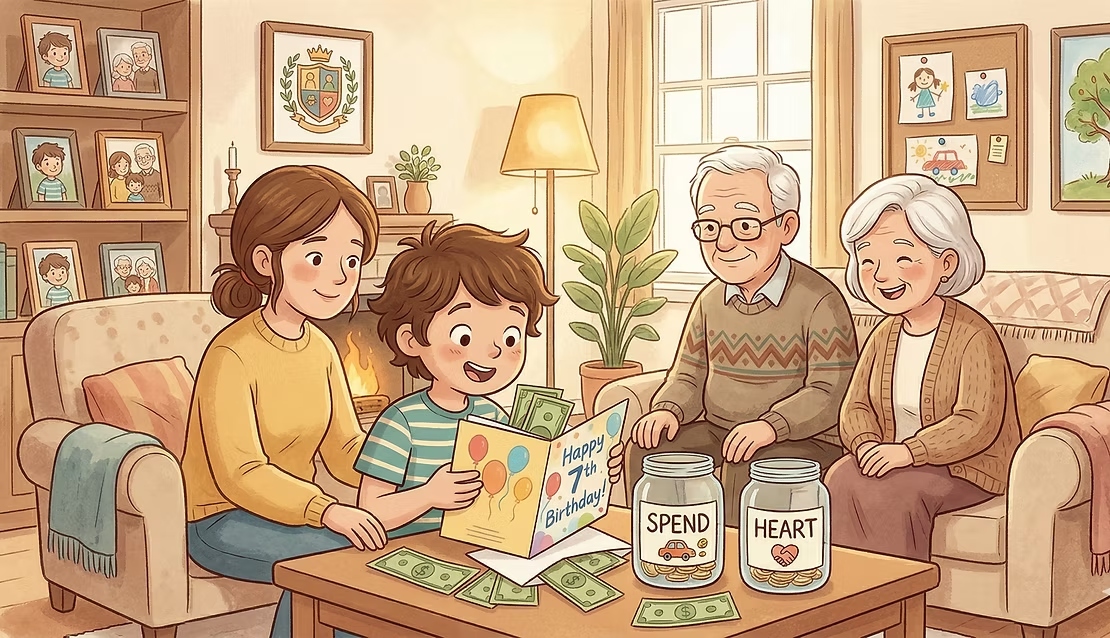
There is something about surprise money that feels different. A birthday card with a crisp bill inside. A holiday envelope from Grandma. A grandparent slipping your child a little cash "just because."
Kids light up. Parents pause.
Because now the question is not just, "What did they get?" It is, "What do we do with it?"
Do you let them spend it all? Do you move it straight into savings? Do you try to turn it into a lesson without killing the joy?
A lot of parents feel awkward in these moments. They do not want to be controlling. They do not want to waste a teaching opportunity either.
The good news is, you do not have to choose between joy and wisdom. Gift money can be one of the best chances your child gets to practice both.
Why Surprise Money Feels So Different
Birthday money and grandparent gifts do not feel like allowance. Allowance usually has some rhythm to it. Some expectation. Some pattern. Gift money feels exciting because it is unexpected. It feels free. It feels like possibility.
That is exactly why it matters. These moments can quietly shape how your child sees money. If every surprise dollar gets spent the second it arrives, they may start to connect money with immediate consumption. If every surprise dollar disappears into savings without their involvement, they may start to feel like money is something adults control and they do not really get to learn from.
What we want is something in the middle — a way to help kids enjoy the gift, while also learning that money can do more than one thing.
A Simple Framework: Save Some. Spend Some. Heart Some.
When surprise money comes in, it does not have to go all one direction. You can teach your child that money has different jobs. Some is for later. Some is for now. Some is for giving.
That is the beauty of: Save some. Spend some. Heart some.
This keeps the joy alive, while giving the money a purpose. It also makes the conversation much easier for parents. You do not have to panic and decide everything in the moment. You already have a rhythm.
Step One: Let Them Enjoy Part of It Guilt Free
If your child receives birthday money and your first response is "Okay, that's all going into savings," the lesson may be practical, but it can feel emotionally flat. Gift money is allowed to feel fun.
Letting your child enjoy part of it teaches them something important too. Money can be used. It can create delight. It can be part of celebration. You might say:
- "This was a gift, so part of it can absolutely be for something fun."
- "You do not have to save every crumb."
- "Getting to enjoy some of your birthday money is part of the gift."
That kind of language matters, especially for kids who lean cautious or fearful with money. It tells them enjoyment is not irresponsible. It just needs balance.
Step Two: Use Some for a Longer-Term Goal
Once they enjoy part of it, the rest becomes a great opportunity. You can ask:
- "Is there something bigger you want to save toward?"
- "Do you want this money to help you get closer to one of your Smart goals?"
- "Would you like to put some of this into your piggy bank or Smart jar for later?"
Instead of only learning, "I got money and spent it," they get to learn, "This gift moved me closer to something bigger." That is a very different story.
Step Three: Heart Some
When a child receives surprise money, it is a great moment to gently remind them that some of what we receive can be used to bless someone else. Not out of guilt. Not out of pressure. But out of habit and joy. You might say:
- "Would you like to use a little of this for your Heart jar too?"
- "Is there someone or something you would want to help with part of this gift?"
- "A small piece can become kindness."
Even a tiny amount matters. This teaches your child that giving is not something you do only when there is "extra." It becomes part of how they relate to money from the beginning.
A Simple Way To Split It
You do not need a complicated formula. Keep it simple and flexible based on the child's age and amount received. For a small amount: a little to Spend, a little to Save, a little to Heart. For a bigger amount: enough to enjoy now, enough to make meaningful progress toward a goal, a small part to give.
The exact percentage matters less than the rhythm. What you are really teaching is: money can do more than one thing, and I can choose where it goes. That is confidence.
What To Say in the Moment
When your child opens the card:
- "What a kind gift."
- "Grandma wanted to bless you with this."
- "This money can do a few different jobs."
When you talk about next steps:
- "Let's decide together how you want to use it."
- "Some can be for fun now, some can be for later, and some can be for Heart."
- "You get to enjoy this and learn from it too."
When they want to spend it all right away:
- "I know it feels exciting to use it all now."
- "Let's pause and think about what your crumbs can do for you."
- "You can enjoy some today and still make a smart choice for later."
How To Loop Grandparents Into the Mission
Many grandparents love giving money because they want their grandchild to enjoy it. They also often care deeply about what that money teaches. If you have a good relationship and they are receptive, you might say:
- "We are teaching the kids Save, Spend, and Heart with their money. Your gift gives us such a great chance to practice that."
- "We are trying to help them build confidence with money, not just spend it fast."
This invites grandparents into the mission without sounding controlling. Sometimes they may even enjoy helping fund a Smart goal or Heart goal on purpose.
What If They Blow It All?
This will happen sometimes. They will get excited. They will choose quickly. That does not mean the lesson failed. It just means there is another lesson now available. Afterward, you can say:
- "How did that feel to spend all at once?"
- "Do you wish you had saved some of it?"
- "What might you do differently next time?"
No shame. No "I told you so." Just reflection.
Why This Matters So Much
Gift money may seem small, but it can shape big patterns. These surprise moments teach kids whether money is only for now or also for later, whether giving is part of money or separate from it, and whether they have a voice in how money is used.
That is why having a simple framework matters. Not because every dollar has to be perfectly managed. But because repeatable rhythms create confidence over time.
One Gift at a Time
You do not need a perfect reaction every time surprise money shows up. You just need a plan simple enough to repeat.
Save some. Spend some. Heart some. Let them enjoy part of it guilt free. Use some to move toward something bigger. Let a little become kindness.
That is how surprise cash turns into confidence. One birthday card. One grandparent gift. One crumb at a time.