
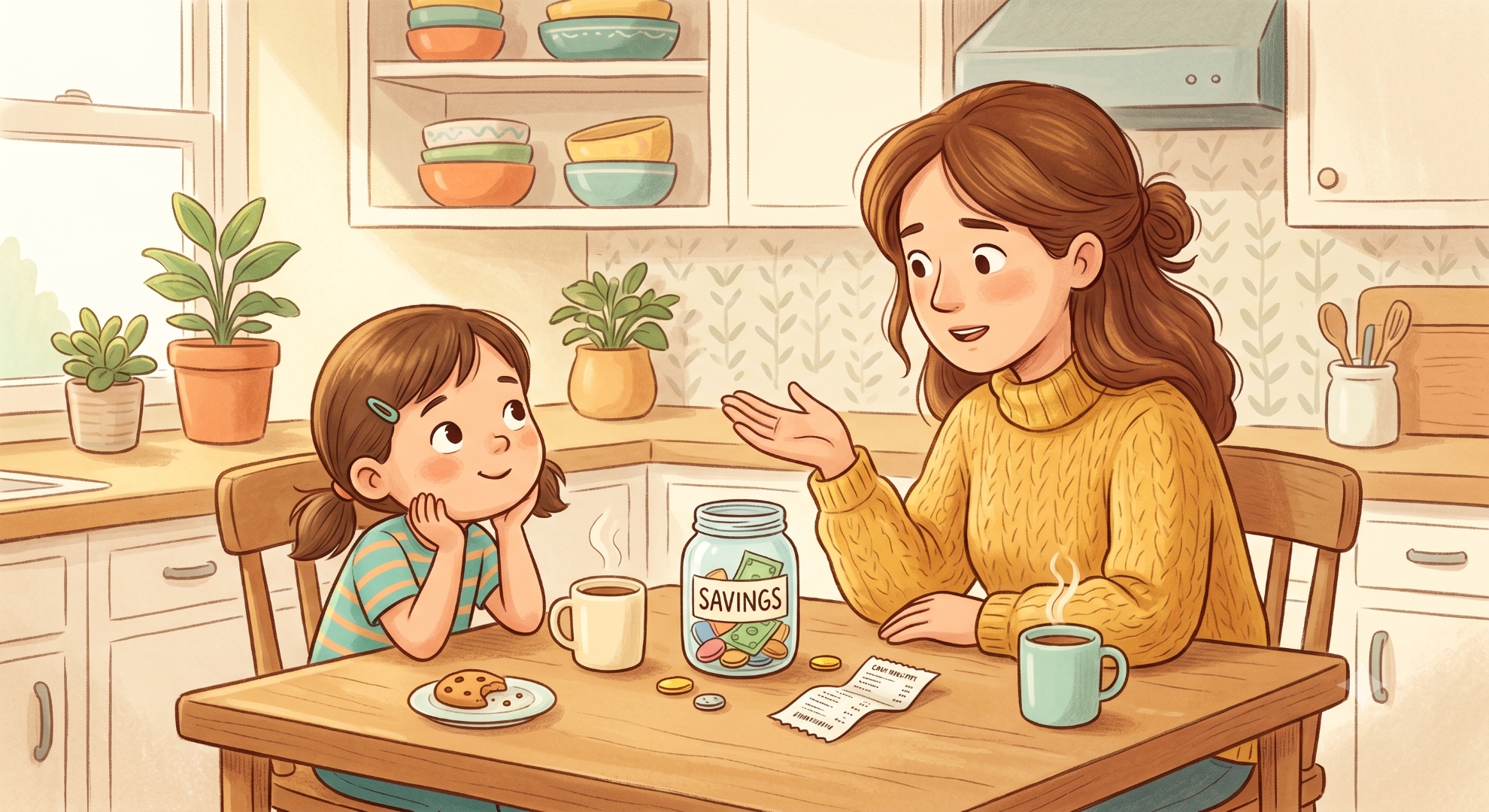
Parents mess up with money too.
You overspend. You forget a bill. You buy something you should have waited on. You feel stress rise in your chest after looking at the account.
That does not make you a bad parent. It makes you human.
The real question is not whether your kids will ever see you make a money mistake. At some point, they probably will. The real question is what they learn from that moment.
Because when parents mess up with money, there is actually an opportunity hiding inside it. A chance to model honesty. A chance to model responsibility. A chance to show your child that mistakes do not have to lead to shame or panic.
But that only works if we know what to share and what to keep adult-sized.
That balance matters. You want to be honest — but you do not want to unload adult stress onto a child. You want to show humility — but you do not want to make money feel scary. There is a healthy middle. And it can teach your child more than pretending you always get it right.
Your Kids Do Not Need a Perfect Money Parent
A lot of adults grew up with one of two pictures. Either money mistakes were hidden and never talked about. Or they were loud, emotional, and heavy. Neither one really teaches confidence.
If everything is hidden, kids grow up thinking mistakes are shameful. If everything is spilled out, kids grow up feeling like money is unstable and scary.
What kids actually need is something steadier. They need to see that grown-ups can make a mistake, name it calmly, and move forward with wisdom.
That is powerful. Because one day, your child is going to make their own money mistake too. And when they do, you want them to think: "I can be honest about this. I can learn from this. I do not have to fall apart."
That starts with what they watch in you.
What Counts as a Money Mistake Kids Might Notice
Sometimes the mistakes are obvious. You say yes to something and later say, "We should not have bought that." Or your child hears you realize you forgot a payment. Or they notice tension after a spending decision. Or they hear you say something like, "I wish I had planned that better."
They may not understand the whole story. But they notice more than we think.
That is why it helps to have a calm way to respond when these moments happen. Not a perfect speech. Just a healthy pattern.
What To Share
Children can benefit from hearing simple, age-appropriate honesty. Things like:
- "I made a money mistake."
- "I should have thought that through more carefully."
- "That was not the best use of our money."
- "I am fixing it."
- "Everyone makes mistakes. What matters is what we do next."
Those kinds of statements do a lot of good. They teach that mistakes are normal. They teach ownership without shame. They teach that money problems can be worked through. That is the kind of honesty kids can grow from.
What To Keep Adult-Sized
There is a difference between honesty and unloading. Kids do not need:
- the exact amount of debt
- the full details of financial stress
- emotional venting about bills or regret
- worst-case fears spoken out loud
- pressure to "understand how hard this is"
Even if your feelings are real, they are not always meant for little shoulders. That is what keeping it adult-sized means.
You can say: "I made a mistake and I'm working on it." — without saying: "I have no idea how we are going to recover from this."
You can say: "We need to be more careful this month." — without saying: "I really messed everything up."
The child does not need the whole weight to learn the lesson. They just need the truth in a size they can carry.
A Simple Way To Talk About It
If your child notices a mistake or asks a question, a good pattern is: name it, own it, show the next step.
- Name it: "I spent money too quickly there."
- Own it: "That was not my best choice."
- Show the next step: "So now I am going to slow down and make a better plan."
That is clean. That is calm. That teaches. It shows your child that mistakes are not the end of the story.
Examples of What You Could Say
Here are a few real-life examples of honest money conversations with kids.
- If you overspent: "I bought that too fast without thinking it through. That happens sometimes. Next time I want to pause first."
- If you forgot a bill: "I forgot to take care of that, so now I need to fix it. Forgetting happens. Fixing it matters."
- If you changed your mind after buying something: "I thought that was a good choice at first, but now I can see it was not really worth it."
- If your child noticed your stress: "I am thinking about some grown-up money things. I do not need you to carry that. I am working through it."
- If they ask if everything is okay: "Yes, we are okay. I made a mistake, and now I am correcting it."
That is honest without making the child feel unsafe.
Why This Builds Trust
Kids trust parents more when parents tell the truth calmly. Not every detail. But the truth.
When a parent can say, "I messed that up," without spiraling or hiding, it teaches a child that money does not have to be wrapped in secrecy. It becomes something that can be talked about. Something that can be learned. Something that can be repaired.
That matters. Because silence around money often creates confusion. And confusion often becomes fear. Calm truth builds trust instead.
What Not To Do
When you make a money mistake, try to avoid these extremes:
- Pretending nothing happened. If your child clearly noticed something and you act like nothing happened, they may start doubting what they see and feel.
- Dumping adult guilt onto them. Things like "I can't believe I did that" or "This is such a disaster" may be honest emotion, but they are too heavy for a child.
- Making yourself the cautionary tale in a scary way. The goal is not to make kids afraid of mistakes — it is to show them how mistakes get handled well.
Let Them See Repair
This part is important. If your child only sees the mistake, they miss half the lesson. Let them also see the repair.
That might mean saying:
- "I made a mistake, so I'm making a new plan."
- "I forgot that payment, so I put a reminder in my phone."
- "I should have waited on that purchase, so this week I'm being more thoughtful."
Now they see that responsibility is not just about avoiding mistakes. It is also about responding well after one. That is a life lesson.
This Teaches Humility Too
Kids do not need parents who act like they always know and always get it right. They need parents who can say: "I am still learning too."
That does not weaken your authority. It deepens your credibility. Humility is not losing leadership. It is showing your child that growth never stops. And when they see that in you, they are more likely to practice it themselves.
How This Helps When They Mess Up Later
One day your child is going to waste money on something silly. Forget a plan. Spend too fast. Feel regret.
When that happens, the way you handled your own mistakes will matter. If they only learned that mistakes are hidden, they may hide theirs. If they only learned that mistakes create panic, they may feel shame.
But if they learned that mistakes can be named, fixed, and turned into something useful — they will be in a much healthier place. That is why your own money mistakes, handled wisely, can actually become part of their financial confidence.
This connects naturally to how to talk to kids honestly when money feels tight — the same principle applies: truth in a size they can carry.
A Good Phrase To Keep Coming Back To
If you want one line that captures the heart of this, try:
"Mistakes are part of learning. What matters is what we do next."
That works for you. And it will work for them too. You can use it when you overspend. When they blow their birthday money. When a plan falls apart. It keeps the focus where it belongs — not on shame, but on growth.
One Honest Moment at a Time
You do not have to be a perfect parent with money. That was never the goal. Your child is not looking for perfection. They are learning from your pattern.
When you mess up, you can show them honesty without panic, responsibility without shame, correction without fear, and resilience without pretending.
That is a powerful model. Sometimes the lesson is not in getting it right the first time. Sometimes it is in showing what healthy repair looks like.
One honest moment. One calm correction. One crumb at a time.