
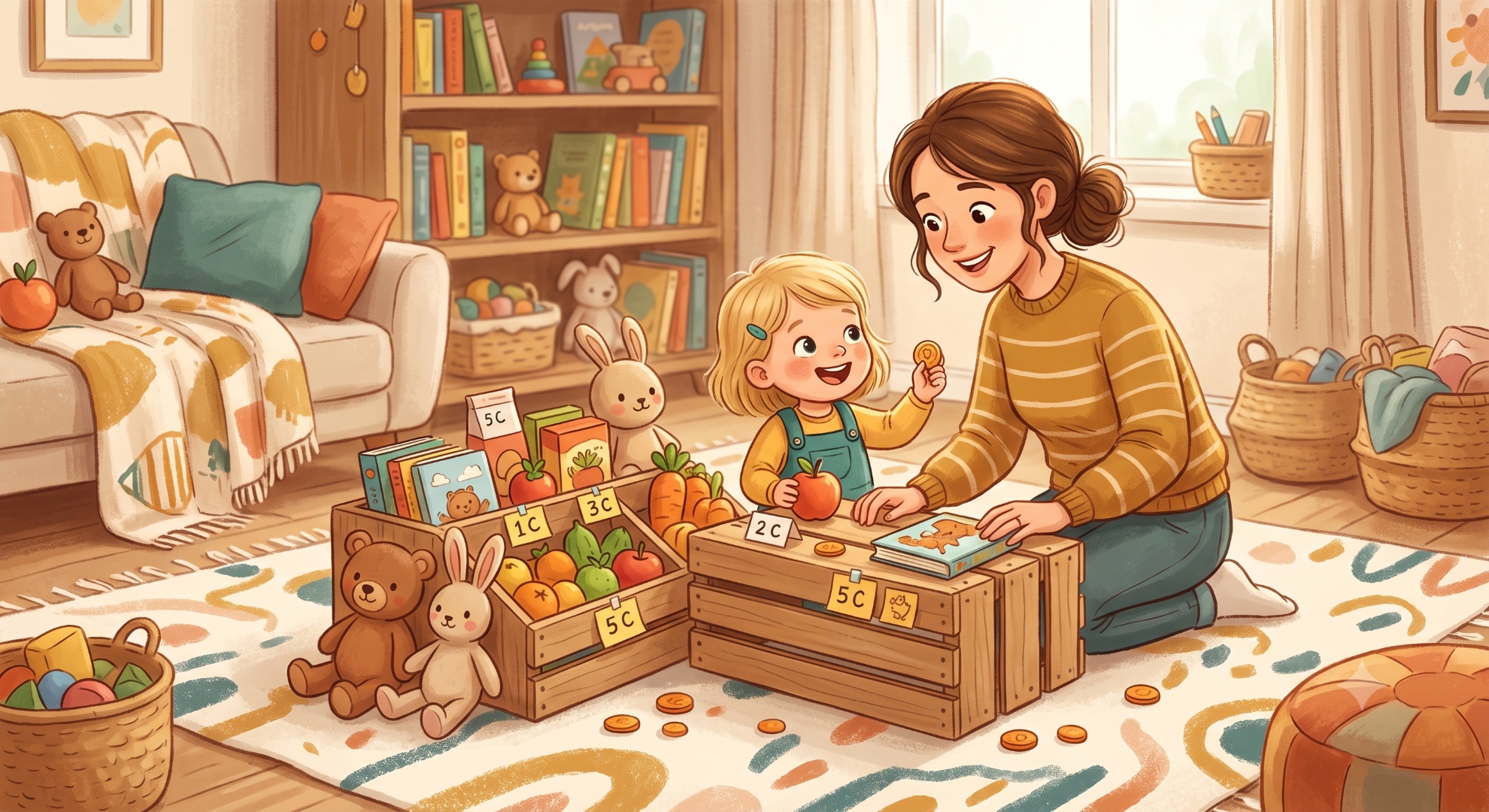
One of the biggest mistakes parents make is thinking money lessons need to feel formal. They do not.
Little kids do not learn best from lectures. They learn through play. Through repetition. Through little moments that feel safe and fun.
That is why pretend play can be such a powerful place to teach money. A few crumbs. A few toys. A little imagination. That is enough.
Because when a child plays store, restaurant, or ticket booth, they are doing more than pretending. They are learning how choices work. They are learning that crumbs have limits. They are learning that using one means not using another.
And the best part is, it does not feel heavy. It just feels like play.
Why Play Works So Well
Young kids need to feel a lesson before they fully understand it. That is what play gives them. It gives them a safe place to practice:
- choosing
- waiting
- counting
- taking turns
- comparing options
- understanding that one crumb can only do one job at a time
That is real money learning. Not because they sat still for a lesson. Because they got to do it with their hands. That matters more than we think.
You Do Not Need Fancy Supplies
This part is important. You do not need to buy a whole pretend money kit to do this well. Most of the best money games use what you already have:
- stuffed animals
- toy food
- books
- paper and sticky notes
- jars and baskets
- a few coins or pretend crumbs
The goal is not to make it look perfect. The goal is to make it simple enough that you actually use it. Because a simple game you repeat will teach more than a "perfect" setup you only do once.
Game 1: Pretend Store
This is one of the easiest places to start. Set out a few items on the floor or table — a snack, a toy car, a book, a stuffed animal. Add simple prices with sticky notes. Then hand your child a few crumbs and let them choose.
You can say:
- "You have 3 crumbs. What do you want to use them on?"
- "If you buy that, how many crumbs will you have left?"
- "Would you rather have one bigger thing or two smaller things?"
You are not trying to make it into school. You are just helping them feel what it is like to choose when there is a limit. That is a huge lesson. To explore more everyday ways kids learn about money, check out that article next.
Game 2: Restaurant Night
Kids love being the one in charge. So let them open a little restaurant. Use toy food or simple snacks. Make a tiny menu. Give each item a crumb price. Then take turns being the customer and the one taking orders.
You can say:
- "What would you like to order today?"
- "You have 3 crumbs. What fits?"
- "Would you like one bigger item or two smaller ones?"
This teaches more than counting. It teaches planning. It teaches that choices come with limits. It teaches that money gets exchanged for something on purpose. And because it feels playful, kids lean in.
Game 3: Ticket Booth
This one is great because it teaches that money is not only for stuff. It can also be for experiences. Set up a little ticket booth for things like:
- movie night
- blanket fort entry
- stuffed animal train rides
- backyard picnic
- dance party tickets
Make little paper tickets and assign a crumb cost. Then ask:
- "Which one feels most worth your crumbs today?"
- "If you spend all your crumbs here, what will you not have left for later?"
Because now your child is learning that money is not just about buying random things. It is about choosing what matters most. That is a lesson many adults still need.
Game 4: Toy Swap
This one helps kids think about value. Lay out a few toys and let your child practice trading or "buying" from the group. Ask things like:
- "Would you trade two small toys for one bigger one?"
- "Which one feels more worth it to you?"
- "If you pick this one, what are you saying no to?"
You are helping your child think beyond "I want it." Now they are learning to ask: "Is it worth my crumbs? What am I giving up? Do I really want this one most?" That is where deeper money thinking begins. It connects naturally to helping kids understand what things are really worth.
Keep the Language Light
This part matters. If the game starts feeling like a quiz, the learning usually shuts down. So keep the tone calm and light. Say things like:
- "You get to choose."
- "You are learning how to use your crumbs."
- "That is one option. What is another?"
- "What feels most worth it to you?"
- "You are practicing."
Those little phrases build confidence. And confidence is what keeps kids open to learning.
What These Games Are Really Teaching
On the surface, it looks like play. But underneath, your child is learning:
- that crumbs have limits
- that choices have trade-offs
- that waiting is part of getting what you want
- that not every yes can happen at once
- that thinking is part of spending
That is a lot of learning from a pretend store on the living room floor. And that is exactly why play matters. It keeps the lesson light. But the impact lasts.
Keep It Easy
If you want this to actually become part of your rhythm, keep it simple. Start with one game. Keep it short. Stop while it is still fun. Repeat it another day.
You are not building a perfect money curriculum. You are just giving your child practice. And that is enough. Once they have the hang of choosing, you can move into helping kids save toward a simple goal.
Because little kids do not need a perfect lesson. They need small moments where they can try, choose, count, and think again. That is how money confidence grows.
One Game at a Time
If you want to teach money well, you do not need to make it heavy. Sometimes all you need is a few crumbs, a few props, and a few minutes where your child gets to play.
That is where the lesson begins. Not with pressure. Not with a speech. With something as simple as a pretend store, a ticket booth, or a toy swap on the floor.
One game. One choice. One crumb at a time.