
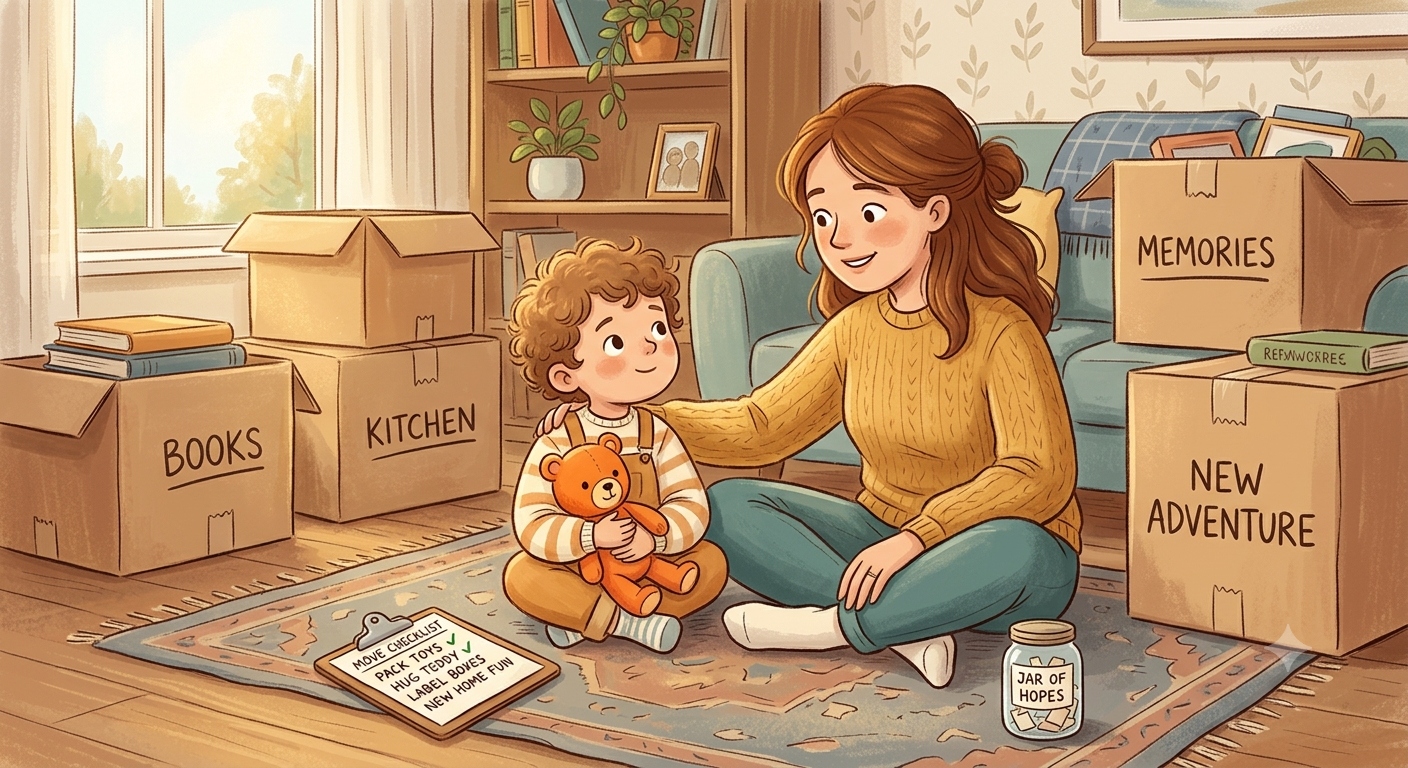
Big life changes and money are almost always connected.
A move to a new home. A job change. A parent going back to work — or stepping away from one. A new baby in the house. A family going from two incomes to one. These transitions carry a financial weight, and kids often sense that weight even when no one has said a word about it.
They notice tension at the dinner table. They hear hushed conversations. They pick up on the fact that things feel different. And when children sense something without an explanation, they tend to fill in the blanks with their imagination — which is rarely more reassuring than the truth.
This post is about how to handle those conversations well. Not by oversharing or turning your child into a small adult with adult-sized worries — but by giving them the calm, honest, age-appropriate language they need to feel safe during seasons of change.
Big Changes Often Bring Quiet Money Changes Too
When a family moves, there are costs. When a job changes, income shifts. When a new baby arrives, the budget gets reorganized. When a parent starts a business, things feel less predictable for a while.
These are real. And even if you never sit down and say "we are making financial adjustments," your child will likely notice something is different. Maybe you say no to something you usually say yes to. Maybe the family skips a vacation this year. Maybe there are more conversations happening behind closed doors.
Kids are perceptive. They notice. What they need from you is not a financial briefing — it is context. Just enough truth to help them understand the shape of things without carrying a weight that was never meant for them.
Think of These as Team Moments
One of the most powerful things you can do during a family transition is frame it as a team moment rather than a problem.
When kids hear "our family is going through a change and we are figuring it out together," they feel included rather than excluded from something scary. They feel safe rather than anxious. They feel capable rather than helpless.
That framing matters more than you might think. A child who grows up hearing "our family works as a team when things get hard" develops a very different relationship with difficulty than one who grows up hearing silence — or stress — when challenges arrive.
Start With What Stays the Same
Before you explain what is changing, lead with what is not.
Children anchor their sense of safety in consistency. When change is happening all around them, what they most need to hear first is: the important things are still solid.
That might sound like:
- "We are still your parents and we still take care of you."
- "You are still going to school."
- "We still have what we need."
- "Our family is still our family, no matter where we live."
That foundation gives them the emotional footing to hear the rest of what you share without it feeling like the ground is disappearing.
Use Simple, Age-Appropriate Truth
Once you have established what stays the same, you can share what is changing — in language that fits where your child is developmentally.
For younger children (ages 3–6), the simplest language works best:
- "Our family is moving to a new home."
- "Daddy is starting a new job soon."
- "We are going to spend our money a little differently for a while."
For older children (ages 7–10), you can add a little more:
- "When families go through changes like this, we sometimes have to be more careful with what we spend."
- "We are making some adjustments so everything works out well."
- "There might be some things we hold off on for now while we get settled."
The goal is truth in a size they can carry — not the full weight of the adult situation, but enough that they are not filling the silence with fear.
What To Avoid Saying
There are a few things that tend to make money conversations during transitions harder for kids, not easier:
- "We can't afford that." — This phrase, repeated often, can quietly build anxiety around money. It focuses on scarcity without context. Try: "We are being thoughtful about spending right now."
- "You wouldn't understand." — Kids are more capable of handling age-appropriate truth than we often give them credit for. Shutting the conversation down creates more worry, not less.
- Venting adult stress in front of them. — "I have no idea how we are going to figure this out" is a sentence that belongs between adults, not in front of small ears. Even if it is true, it puts adult-sized fear into a child-sized heart.
- Sudden dramatic changes without explanation. — If things change overnight with no context given, kids often assume the worst. A short, calm explanation goes a long way.
Give Them a Role, Not a Burden
One thing that helps children feel capable during a transition is giving them a small, concrete role to play — not as a burden, but as a contribution.
That might look like:
- Letting them help pack a box when moving.
- Asking them to think of one free activity the family could do together this weekend.
- Inviting them to help pick which restaurant to skip this month and which to keep.
- Letting them have input on something small within a tighter budget.
When a child feels like they have a part to play — even a tiny one — they shift from feeling like something is happening to them, to feeling like they are part of a team working through it together.
Repeat the Family Team Message Often
One conversation is never enough. Children need to hear the same reassuring message multiple times before it really settles in.
That means coming back to it. Not making it a heavy, sit-down talk every time — but naturally checking in:
- "How are you feeling about the move?"
- "Any questions about what's going on with the new job?"
- "Just want you to know — we are doing great. Just making some adjustments."
Repetition is not redundancy here. It is reinforcement. Every time you return to the message calmly, you are essentially saying: this is still okay, we are still steady, you are still safe.
Keep One or Two Routines Steady
During transitions, routines become anchors. When so much is in flux, something familiar and predictable helps a child regulate emotionally.
It does not have to be big. A Friday movie night that stays even during the move. The same Saturday morning pancake tradition even during a tough budget month. A bedtime reading ritual that continues through the job change.
These small consistencies communicate something important without any words at all: even when things change, some things do not. That is enormously settling for a young child.
If They Ask Bigger Questions
Sometimes children will ask bigger things. "Are we going to be okay?" "Are you going to lose your job?" "Are we poor now?" "Do we have enough money?"
These questions deserve calm, honest answers — not panic and not deflection.
Some phrases that can help:
- "Yes, we are going to be okay. We are working through some changes, and we will get through them."
- "We have what we need. Some things might be different for a while, but we are okay."
- "That is a grown-up question, and I love that you asked. Here is what I can tell you: our family is strong and we take care of each other."
You do not have to answer every detail to answer honestly. You can hold the truth and hold the boundary at the same time.
Teach Them That Adjusting Is a Strength
One of the most valuable things a child can learn during a family transition is that adjusting is not a sign of failure — it is a sign of wisdom.
When you model flexibility without panic, you are teaching your child something money books never cover: that resilience is not the absence of hard seasons, but the ability to move through them with your character intact.
You can say this plainly:
- "Smart families adjust when things change. That is what we are doing."
- "Being flexible with money is actually a skill. We are practicing it right now."
- "Every family goes through seasons. This is one of ours, and we are handling it well."
That reframe turns a potentially scary moment into a lesson in strength.
What You Are Really Teaching
When you talk to your child calmly during a financial transition, you are not just managing a hard moment. You are building something.
You are building their trust that you will tell them the truth. You are building their belief that the family is a safe team. You are building their capacity to handle uncertainty without falling apart. You are building their sense that money is something that can be talked about, adjusted, and managed — not something that is hidden, feared, or shameful.
These are the roots of financial health. And they grow best not in the easy, comfortable seasons — but in the ones that require a little more from everyone.
This connects naturally to how to talk to kids when parents make money mistakes — the same steady, honest approach applies whether you are navigating a mistake or a major life change.
One Safe Conversation at a Time
You do not have to have the perfect conversation. You just have to have a calm one.
Show up steady. Start with what stays the same. Give them truth in a size they can carry. Let them have a small role. Keep one routine going. Repeat the message that your family is a team.
Do that, and your child will come out of this transition not just okay — but stronger. More adaptable. More trusting. More equipped for every season of life that comes after this one.
One crumb at a time.